Data Centers, the Climate Crisis, and Community Defense
How Local Activists are Interrupting Big Tech AI Investments
As Trump’s Energy Secretary Chris Wright claims you should “build data centers” if “you want low electricity prices,” more than 200 environmental organizations have joined to “demand a halt to the building of new AI data centers.”
Why? Ecologists and other scientists are sounding the alarm about the deleterious effects of AI and data centers on the climate and the health and economic conditions of local communities, while Big Tech giants are lobbying politicians like Wright and Trump to dictate the media narrative, state investments, and municipal zoning laws. And the cops are helping them do it.
There are 4,296 energy-sucking AI data centers in the United States at the time of this article’s publication, and the reports confirm: data centers hurt the most disenfranchised populations the most.
- Sam Altman’s “AI empire” alone is using as much power as New York City and San Diego, combined
- Google’s AI data centers are consuming massive amounts of power, with electricity use hitting 30.8 million megawatt-hours in 2024, nearly doubling since 2020 — while inking deals with the Israeli military
- Elon Musk’s xAI has constructed the world’s largest AI supercenter, Colossus, in one of the poorest neighborhoods in one of the country’s most impoverished cities
Nevertheless, despite the urgency, the typical AI conversation still centers around job loss, algorithmic bias or data privacy, while mostly ignoring the ecological and economic costs that disproportionately harm what Mozilla fellow Paz Peña calls the very “populations most closely connected to the land and agriculture, such as rural women, indigenous peoples, and people of color.”
Poisoning for Profit
By 2027, global AI data centers could consume up to 1.7 trillion gallons of water each year. And, as reported in Essence, water’s only the beginning:
“Data centers’ enormous energy demands often lead to the construction or expansion of nearby fossil fuel-powered plants. This introduces air pollutants such as nitrogen oxides and formaldehyde, which worsen respiratory conditions like asthma… Additionally, pressure on local power grids can lead to increased electricity costs, deepening energy insecurity for families already struggling to make ends meet.”
In drought-prone or water-stressed areas, the risk is even greater, with the diversion of billions of gallons of water to cool AI servers “threatening not only household water access but entire ecosystems,” according to the Essence report.
Related: ‘Teslastoppen’ Elon Musk’s Water War in the Heart of Europe [April 2024]
Meanwhile, the economic benefits touted by AI companies and contractors rarely come to fruition for the communities where data centers are built. “Though marketed as job creators, data centers typically offer a limited number of highly specialized roles that are often inaccessible to local residents…
“Rather than closing the wealth gap,” Nia Berkeley writes in Essence. “These centers can exacerbate displacement and economic inequality.”
In Memphis, environmentalists and community activists say the location of Musk’s appropriately named Colossus “is no coincidence;” according to Essence, “it mirrors a long history of environmental racism where polluting industries and hazardous developments are placed in communities with the least political and financial power.”
Unicorn Riot asked Dillon Mahmoudi, Associate Professor in the Department of Geography and Environmental Systems at the University of Maryland, Baltimore County, to extrapolate.
“The concentration of heavy industry, toxic facilities, and chronic infrastructural neglect in environmental sacrifice zones has exposed [Black, Indigenous, and People of Color] populations to heightened pollution and environmental hazards,” he said. “As a result, these communities face greater difficulty building resilience and experience deeper harms from the increasing occurrence of disasters driven by the climate crisis, and heightened by the rapid data center buildout, fueled by the speculative AI boom.”
Sha Merirei Ongelungel went a step further.
“From ‘Cancer Alley’ in Louisiana to the chemical valley around the Aamjiwnaang First Nation in Canada, Black and brown communities are turned into ‘sacrifice zones.’ And none of this is accidental. It’s all by design. Powered by colonialism, extractivism, and industrial-scale theft,” the Palauan-American activist and artist told Unicorn Riot.
“The same systems that made sure Black, Indigenous, and other communities of color were last in line for clean air, safe housing, and political power are the same ones making sure we’re also first in line to drown, burn, or be displaced.”
The AI Data Center Boom
Fittingly, then, the location of the world’s ‘biggest supercomputer’ in Memphis is only a few miles from Boxtown, a predominantly Black community with a median income of $37,000, or barely half of the average for the city.
As illustrated by the Brown Undergraduate Journal of Public Health, this is “environmental racism.”
“You can see it easily in places like Louisiana’s ‘Cancer Alley,’ or the Southwestern Indigenous reservations cut off from access to the dwindling Colorado River, or in Altadena’s slow recovery from this year’s fires,” Slatetech and business writer Nitish Pahwa told Unicorn Riot.
And it’s only getting worse as megacorps collude with local, state and federal rungs of the government to construct new, bigger, more powerful and more toxic AI data centers to power the LLMs taking over the internet.
The xAI Colossus data center Musk built in Memphis consists of 230,000 Nvidia GPUs and requires 35 unpermitted gas turbines, which pump out “a level of emissions” that environmentalists agree are aggressively “exacerbating the health issues of an area already crushed by decades of pollution.”
As documented by Honor the Earth, “Huge data centers are popping up… devouring land, water, and energy. Every major tech company, including Amazon, Google, Meta, Microsoft, Apple, and OpenAI (ChatGPT) [is] racing to build massive, multi-billion-dollar data centers without tribal or local community consent, at the cost of our water, health, land and energy bills.”
In Illinois last year, AI caused an entire neighborhood to vacate forever; a Big Tech company bought every house in the unincorporated Elk Grove Village, and today all that is left is a massive data center.
Worse, Pahwa said, in most instances, “residents have little choice but to stay in these neighborhoods, since they’re more affordable — thanks to depressed property values from outside damages.”
In nearby Indiana, reports Indiana Economic Digest, the new 619-acre, $800-million Meta data center coming to River Ridge Commerce Center in Jeffersonville received a 35-year sales tax exemption, while the community (and state) was left “to make some tough decisions on how we’re going to generate power to feed the demand.”
In Oregon, AI data centers have been linked to drastically increased rates of rare cancers and miscarriages — even in young adults. Amazon’s first AI data center began operations in Morrow County in 2011, pulling water from the local aquifer; today, there are seven in the area, each polluting and consuming millions of gallons of water per day. And even with nitrate levels in drinking water already far exceeding the local limit thanks to data center-related pollution, Amazon is expanding its data centers across the state, with five more already planned — while enjoying the billions of dollars saved in 15 years of tax abatements for each hyperscale data center built.
Oregon’s economics lay bare the reality facing communities across the country. According to a Rolling Stone report, in Morrow County, for instance, 40% of residents live below the poverty line, 30% live in mobile homes, and the vast majority rely on the now heavily polluted well water from the aquifer. Meanwhile, the top 5% bring in an average annual income around $375,000, or more than 20 times the bottom 20%; most live in mansions on the outskirts of the farmlands, drinking and cooking with water from city pipes delivering less contaminated water.
These are the current effects of the multi-billion-dollar AI data center land grab — with Big Tech looking to consume the most energy, at the lowest cost, while only harming the poor and Black people and people of color to outpace competitors in the AI arms race.
As Great Lakes organizer and environmental nonprofit founder Samuel Seth Bernard told Unicorn Riot, “BIPOC communities have always been disproportionately impacted by environmental degradation, and it is certainly the case with data centers.” Black, brown, Indigenous and poor white people “have also historically been denied the human right to clean, safe, affordable water.”
In Michigan, as Bernard explains, the financial burden, then, also falls on these most-vulnerable communities.
“Here in Michigan,” he said, “some of the highest utility rates in the country are being paid by BIPOC-majority communities like Detroit, and these rates are expected to skyrocket.”
In California, “the hidden data center in Monterey Park” is moving forward with a plan to allow the construction of a massive data center that would require over 300% more electricity than what the entire city uses now. The proposal would demolish existing buildings and replace them with a 218,000-square-foot data center supported by 14 emergency diesel generators.
According to local organizing group SGV Progressive Action, the community was not “adequately informed, represented, or included in this process,” and no alternatives were considered.
Meanwhile, SVG Progressive reports, the Monterey Park data center would create few jobs, but significant habitat loss, utility rate increases and taxpayer costs for accompanying substations, transmission lines and water system upgrades — while producing profits “only for large corporations.”
In Tucson, Arizona, the people voted against a gigantic AI data center, and Amazon is building it anyway. As reported by More Perfect Union, the plan, Project Blue, is still in the works in Pima County, based on a recent letter from the contractor Beale Infrastructure. Beale is focused on developing large-scale data centers across North America, “partnering with tech giants” not only in Arizona but also in states like Oklahoma and Kansas.
As one Arizona organizer told More Perfect Union:
“If you are going to come in to my community, and you are going to harm my neighbors, fuck off. If you’re not going to be bringing anything in, and you’re going to lie, and you’re going to cheat, and you are going to bribe, you are going to be met with equal energy.”
Concurrently, former Arizona Senator Kyrsten Sinema has been “working hand-in-glove with the Trump administration,” lobbying on behalf of data center development firm Active Infrastructure to build a new $2 billion data center in Chandler — or face federal intervention.
In Roanoke, Virginia, Google is building in secret, again, according to the Roanoke Rambler. In June, Botetourt County leaders announced that Google had purchased 312 acres of land in an industrial park for a potential data center project.
“The tech giant promised to spend at least $1 billion per data center, and county officials celebrated the potential tax windfall and new jobs… But many aspects of the potential project remained shrouded in secrecy — including how many data centers are under consideration and how much energy and water they would use.”
Officials said the water needed would initially come from Carvins Cove. However, a leaked July draft agreement between the county and the water authority highlights a plan to provide Google’s data center with two million gallons of water per day, and to increase that to eight million gallons for future expansions. The data center would use between seven and 30 times as much water as even the area’s longtime largest energy user, the Coca-Cola bottling plant.
When taken to court, Roanoke Circuit Court Judge Leisa Ciaffone said “there are few resources more precious than water,” and the public has “an overwhelming interest” in how government officials respond to requests to build AI data centers.
“Public participation in the data center discussion on a local level is especially critical,” she said, “given that this is an industry still in its adolescence, with virtually no state-wide regulations.”
As more than a dozen states with AI data centers face potential electric power emergencies under extreme winter conditions, federal guidelines since mid-2025 have focused primarily on promoting the fast-tracking of data center projects.
The AI Data Center Resistance
In response, organizers are coalescing around Big Tech “threaten[ing] to derail the U.S. data center boom.”
Residents and local officials have together successfully opposed planned data center projects in municipalities as diverse as Archbald, Pennsylvania, Indianapolis, and Chesapeake and Pittsylvania, Virginia. According to a 2025 Data Center Watch report, this resulted in more than $60 billion worth of installations being delayed or killed outright between May 2024 and March 2025 alone.
“The solutions are clear and must be rooted in climate justice,” Amazon Watch Deputy Director Paul Paz y Miño told Unicorn Riot. “For starters, we need to stop importing Amazon crude and uphold Indigenous rights to keep forests standing. Not only because searching for more sources of crude is counter to climate goals, but also because Indigenous stewardship is one of the most effective climate solutions we have.”
At the same time, he continued:
“We must make sure AI’s growth is powered by real, additional clean energy, not dirty fossil fuels, and that the costs aren’t dumped on vulnerable communities. That means tying data-center approvals to new renewable build-out, shutting down peaker plants in frontline neighborhoods first, and ensuring water and energy policies are guided by equity.”
The Global Director of Human Dimensions Science at The Nature Conservancy, Philip Loring laid out a three-pronged approach.
First, “those of us in positions to speak up, should. We create actual change by rejecting the lie that all we need to do is develop fancier and more efficient technologies to make these environmental problems go away.”
Second, “opt out of the systems that perpetuate and thrive on environmental racism and injustice. They want us to think we change the world by buying different things; I say we change it by opting into alternative systems that disrupt it.”
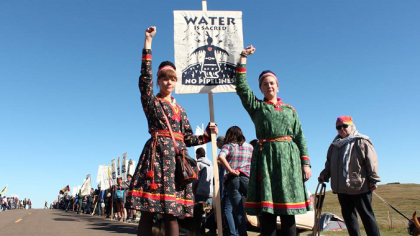
Finally, “look to how Indigenous peoples have used blockades and other forms of direct action to stop pipelines. Direct action works, which is precisely why we’re seeing moves in the Trump Administration to impinge on our right to engage in direct action, by criminalizing protests and framing anti-fascism as terrorism.”
As Loring acknowledged, “this administration feels very powerful,” but, he added, “they are tremendously unpopular — and I’m confident that if we rally around each other, and stand up for one another, we can have tremendous impact.”
Additionally, added Peña, “Solutions must be tailored to diverse realities; there are no one-size-fits-all answers.”
She, too, suggested three tactics for reclaiming control of our communities:
- Political. “Governments must ensure that the digital transition and AI-driven economy do not compromise the human rights of individuals, and particularly the most vulnerable communities.”
- Socio-technical. “Innovation alone is insufficient without addressing the various socio-environmental challenges posed by these infrastructures.”
- Community. “The people must lead the energy and digital transitions to create genuine economic and social benefits for everyone, not just select groups.”
From his organizing efforts, meanwhile, Bernard has seen “folks successfully stop data centers by passing memorandums, adopting ordinances, and changing zoning laws.”
Another strategy is “to simply delay the projects,” which puts additional pressure on the tech companies, who have already taken on massive debt. “Public resistance threatens investor confidence,” he said, “and public resistance is spreading like wildfire.”
Not only that, the AI data center resistance movement is spawning a new generation of leaders, Bernard explained. “What lies beyond this bubble is a new kind of politics, where the public officials who supported these projects are gone, and the people on the ground who resisted them are taking office with the true interest of the people in mind.”
About the author: Phil Mandelbaum is an award-winning journalist, a co-creator of the content services division of The Associated Press, a nonprofit and political strategist, and an organizer and artist, also known as awkword.
Follow us on X (aka Twitter), Facebook, YouTube, Vimeo, Instagram, Mastodon, Threads, BlueSky and Patreon.
Please consider a tax-deductible donation to help sustain our horizontally-organized, non-profit media organization: